When I was eighteen, I did civil service as a teaching assistant at a high school in Tel Aviv. There were eighteen of us sharing a very large house in Florentin.
Several of us were also studying for the psychometric entrance exam. That involved learning a lot of vocabulary, including words that were unlikely to turn up in a normal conversation in our kitchen.
We were busy. We needed to practise. At some point, the vocabulary cards ended up in the toilet.
If you were already sitting there, you could go through a few.
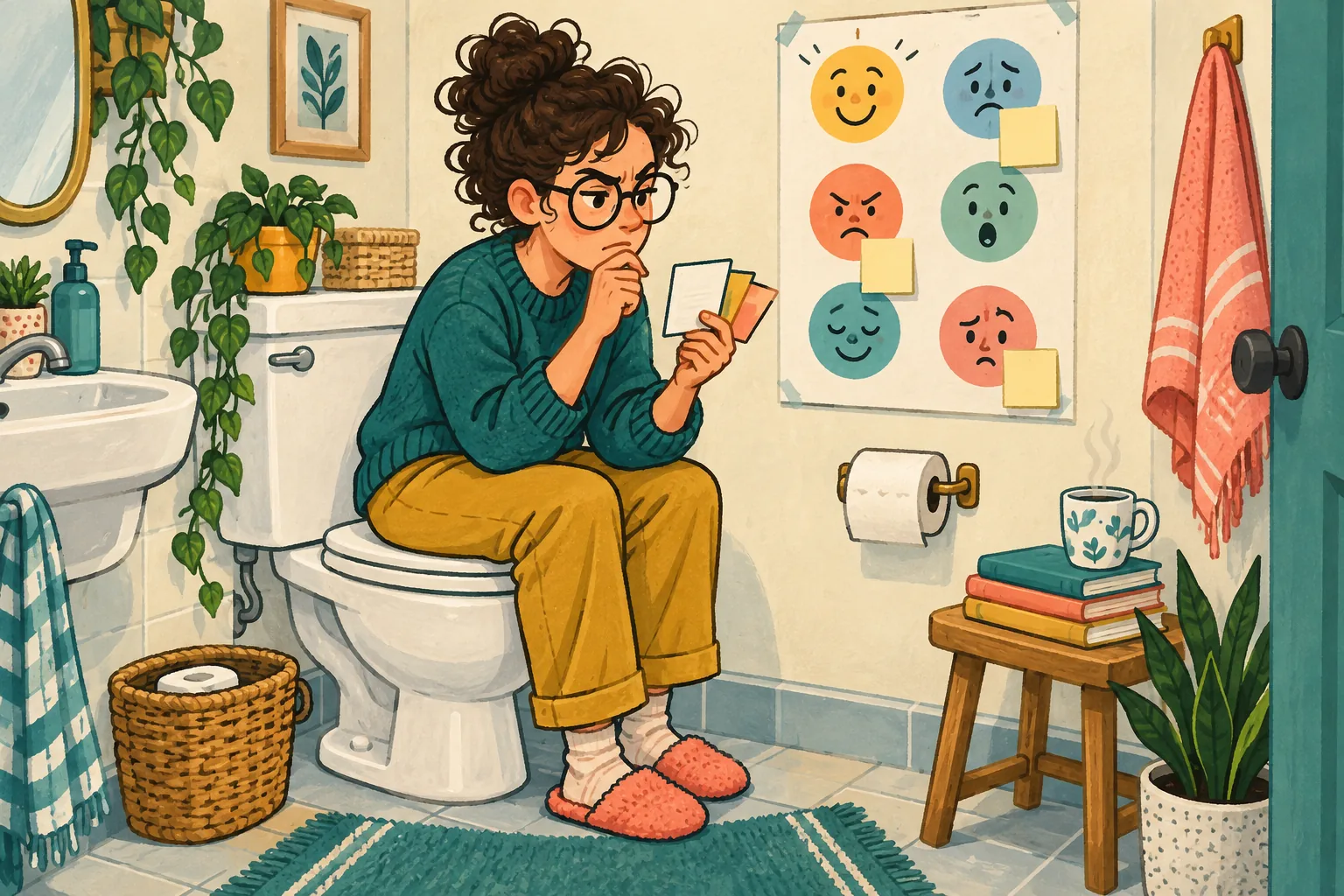
I later used a version of this for language learning: a vocabulary poster on the wall, where I could look at it during a visit. It is an odd place to put a study aid, but it gave me a regular opportunity to use one.
Put something useful on the wall
Choose a small group of words or phrases you are trying to learn. Print them or write them clearly on a sheet of paper. Put it somewhere you can read it easily.
This works especially well as a companion to labelling objects around your house. Objects already have somewhere to put a label. Feelings and phrases are a little harder to stick to the furniture.
A poster could hold words for how you feel, or a few expressions you would like to use during the day.
For example, a small feelings poster could include:
- שמח / שמחה — sameah / smeha — happy.
- עייף / עייפה — ayef / ayefa — tired.
- רעב / רעבה — ra'ev / re'eva — hungry.
The masculine form comes first in each pair, then the feminine form. Ask your teacher to help you practise the form you use and hear how it sounds in a sentence. אני — ani — I can go before these words: ani ayef or ani ayefa means “I'm tired”.
You could draw a simple face beside each feeling. Leave enough space to cover the Hebrew without covering the picture.
Start hiding the answers
At first, read the words and say them. As they become familiar, cover one of the answers with a small piece of paper and try to recall it from the picture.
Then check. If you have forgotten, uncover it and practise again.
Gradually cover more answers. You can also try using each word in a short phrase rather than just naming the feeling.
This is the part I would keep even if you choose a completely different wall for the poster. Give yourself a chance to answer before looking. A poster you glance at without thinking can eventually become as invisible as all those labels in my student's house.
Replace it before you stop noticing it
After a week or two, check whether the poster is still useful. Keep practising the words you need, and replace the ones you know with a new small set.
A desk or the inside of a cupboard door can work too. Choose somewhere you already pause, where you can comfortably look at a few words.
And if you share a bathroom, keep the practice brief. The other people living with you might need to use it too.

Yaron Sivan
Yaron founded Ulpan Bayit in Tel Aviv. He writes about teaching Hebrew, learning other languages, and the things that happen along the way.